Tuesday, March 13, 2012

Eureka! The personal genome gold rush gets going.

Recently I spent a highly energizing evening at the MIT Enterprise Forum in an Innovations Series Event called “The Future ofthe Personal Genome.”  Kevin Davies, Editor-in-Chief of Bio-IT World, moderated a panel of four leaders in the personal genome world: Colin Hill, CEO of GNS Healthcare, Mike Pellini, CEO of Foundation Medicine, George Church of the Personal Genome Project, and Jamie Heywood, Chairman of PatientsLikeMe.  Topics included everything from how to spur the public to see the benefit in personal genome sequencing to how to make this information more actionable in a clinical/healthcare setting. But what I was thinking was that the personal genome gold rush was finally beginning in earnest.

Three examples:

Bioinformatics: We have been talking about “drinking from the fire hose” since automated DNA sequencing began in the late 1980’s, but the rate of data generation today is amazing. What persists today is the challenge of interpreting all of this data. Illumina, LifeTech, Complete Genomics, and others, have an unprecedented need for computational biologists. High throughput biology is accelerating, as is the need for programmers, engineers, analysts, and architects. As I write, a small Cambridge-based company (and client), Knome, has seven positions open. Life Technologies has about twenty-three. Just about every company I looked at has an opening for at least one software engineer/programmer. Prediction: We will need to aggressively train new graduates in this area and poach from other technology sectors such as aviation, astronomy, and academia going forward.

DNA Diagnostic Leaders: Of course, blood gas measurements will never go away, but the new opportunity is for genomic scientists and commercial people who can usher in new genomics tests, while respecting current medical practice, privacy issues, and reimbursement requirements. Consider, for example, companies like Foundation Medicine, which are sequencing patients’ individual tumors to deliver on the promise of personalized medicine. Or Good Start Genetics, next-gen sequencing for routine genetic-carrier screening. Although the technologies are potentially game-changing, the challenges of incorporating these new approaches into existing healthcare paradigms remains, and we need people with experience gaining FDA approval and selling to the clinical market. Don Hardison, CEO of Good Start Genetics, has addressed this challenge by hiring many of his former team members from Exact — people with solid molecular diagnostics experience, to complement some of the NGS expertise in the company. Prediction: There are not enough people with DNA sequencing and diagnostics experience to feed these new companies. Cross-training classic diagnostic experts with NGS experts will be the wave of the future. Lots of opportunities moving forward especially for recent graduates.

Sales & Marketing: The platform race is accelerating. Companies such as Oxford Nanopore and Nabsys will continue to develop cutting-edge solutions and will need commercial leaders to bring products to market. Oxford Nanopore is searching for a VP of Sales as I write. Darren Lee just started at Nabsys this week as VP of Marketing and Business Development, and I am sure NobleGen, GenapSys and others are not far behind in their recruiting efforts.

These are just a few areas. When you remember the potential jobs in related fields such as education, clinical genetics, and patient care, you realize that the opportunities starting to open really could be of a gold-rush scale. Look for the confirmation of these positive trends — many of them associated with increased personal genome activity — in the soon-to-be-released new edition of the edition of the US Department of Labor’s Occupational Employment Statistics (OES) survey for 2012-13.

 And saddle up, everybody — thar’s jobs in them thar genome hills!


Wednesday, January 18, 2012

Highlights of the JP Morgan Healthcare Conference 2012

There’s never a better way to kick off a new year than to join the mobs descending on San Francisco for the annual JP Morgan Healthcare Conference —especially after a year that saw its ups and downs. The place was teeming with investors trying hard not to think of the European financial situation; with companies in search of funding; with industry leaders, insiders and observers of all stripes. And every one of them networking furiously. It’s biotech’s version of mass speed dating. At JP Morgan, if you don't have an invite, you can still get in on the action. Lots of conversations happen on street corners, in wildly-packed hotel lobbies, and during receptions (over a glass or two) at some off-site venue.

Some of the highlights this year, official and not, included exciting announcements, progress on the Next Gen Sequencing front, and of course cost containment & acquisition plans for 2012.

Mixed news
First the good stuff. Noubar Afeyan, who was celebrating his nineteenth JP Morgan conference, looked jubilant after the announcement that Flagship Ventures closed Fund IV. At $270 million, Fund IV is the largest fund yet in the Flagship portfolio. Watching what he is doing with JOULE and with talented people like David Berry is just plain fun. Can't wait to see how he spends his money.  In more Flagship news, on Monday, one of Flagship’s portfolio companies that’s near and dear to my heart, BG Medicine, announced a new CEO: Eric Bouvier, PhD. It’s going to be an exciting place for Eric to be, as BG seems to be making true headway with its transformative galectin-3 and AMIPredict diagnostic tests.

Obviously, after a year like this, there was some gloom. Francis Collins named one of the elephants in the room, talking about decreased NIH funding (down significantly from nine years ago). The odds today are that new investigators only have a one in six chance of funding, as opposed to the one in three chance of years past. On the positive, Dr. Collins shared his excitement over the plethora of new discoveries made every day by scientists. He also described the objectives of the new NIH Institutes and the $140 million partnership between NIH and DARPA to develop a chip-based approach to drug toxicity testing. One growth area surely seems to be on the molecular diagnostics side, with Qiagen, Cepheid, Gen-Probe and others all launching new tests and/or platforms.

Next Gen Sequencing forging ahead
Another positive: As a big fan of the $1000 genome efforts, I was happy to hear about Life Technologies’ Proton Torrent announcement of the $1000 genome instrument. It was also great to see Illumina fired back with its instrument upgrade announcement. The latter was perhaps smaller news, but the larger story — that this is a technology space jumping with activity — is all good. One of the biggest buzzes seemed to be about the PacBio news that Hugh Martin is out and Mike Hunkapiller is now CEO. The word is that this is not as abrupt as it looks. Mike apparently has been working closely with the PacBio team for quite a while. And of course, Mike has a plan. We wish him the best of luck in his new capacity.

Tough 2011 but solid plans for 2012
Many of the presentations reflected just how tough last year was, with NIH grant scarcity and very cautious customers. But what struck me was how persistent, tough, and never-say-die this industry really is. Frank Witney, CEO of Affymetrix, gave his update about his company’s difficulties in the last half-year. Even with a 20% cut in R&D as a cost savings measure, however, he remains bullish about their CytoScan HD product.

Thermo also announced cost-savings programs. The $55M they save will offset reduced customer spending and NIH cuts. Perkin Elmer revealed that no new acquisitions will be made until they finish the Caliper Life Sciences integration. Fluidigm is focusing on expanding into new market segments including cell culture, molecular diagnostics, and protein expression as well as will be considering acquisitions in the future. All in all it seems that companies remain optimistic and continue to look for creative ways to be successful.

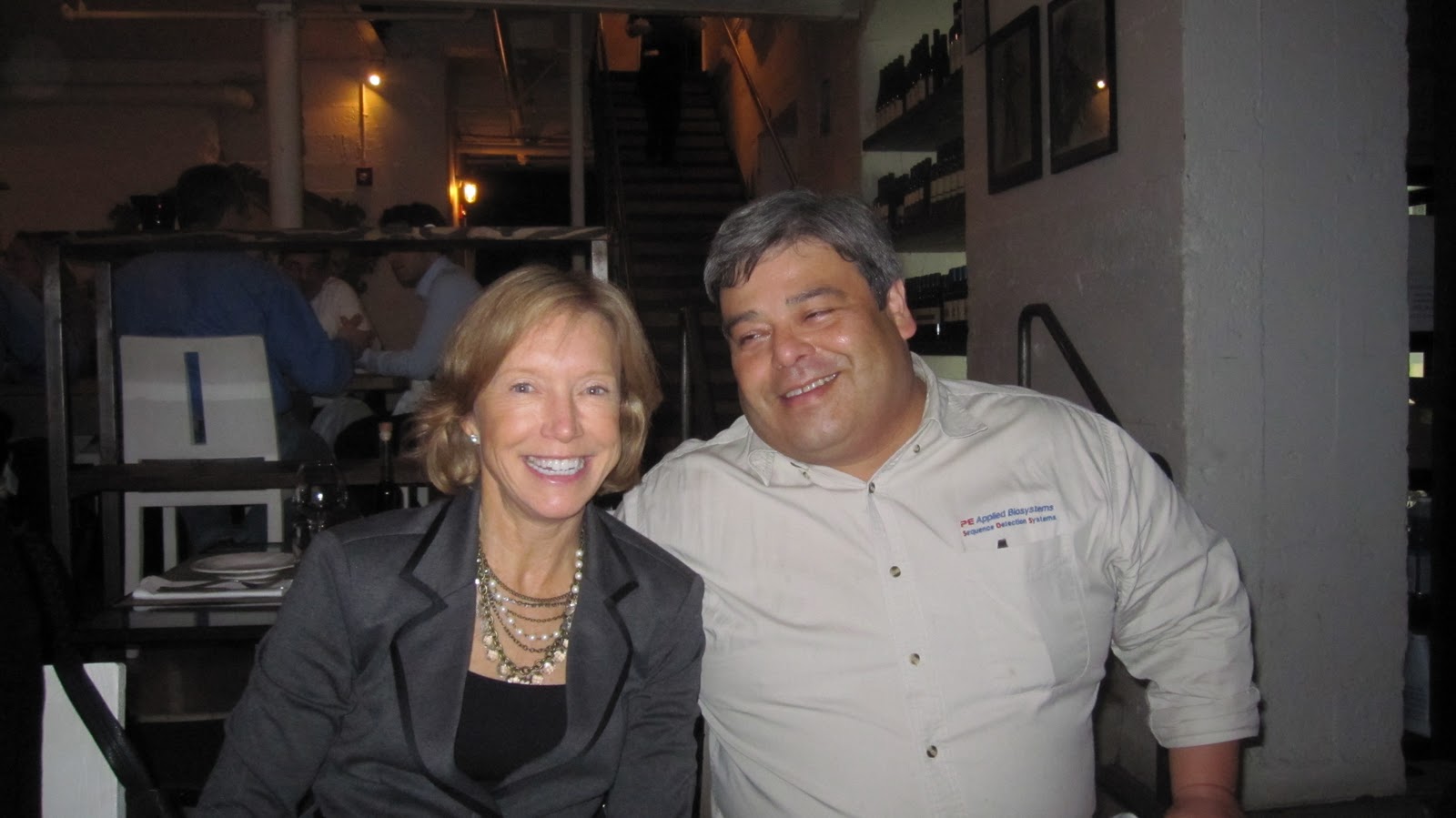
Taking a break On the personal side, one of the highlights of my JP experience this year was an unofficial Applied Biosystems (ABI) get-together that Linda Avey (cofounder of 23 & Me now CEO/founder of Curious, Inc) and I hastily planned. She’s something special, with entrepreneurial star power to spare and plenty of courage to shake things up. Makes me remember how fortunate I was to work with Linda and many of the others that were able to join us. What good friends I made: impressive professionals and wonderful people who work hard to make a difference in life sciences and human health.


Sunday, January 1, 2012

Five Old-Fashioned New Year’s resolutions every bioscience worker should make.


It's been yet another roller coaster of a year in the bioscience industry: lots of excitement, but some real lows, too. PerkinElmer acquired Caliper, but announced layoffs. Pacific Bioscience, a high flyer early in 2011, is perhaps now plummeting to earth: it laid off 130 workers. Even the golden child of life science tools, Illumina, has had sluggish sales and recently announced it will shed 8% of its workforce. Sometimes it’s not easy to hang on, much less enjoy the ride.

Not surprisingly, I get many calls from people looking to find a new job in the short term and/or to optimize career options for the long term. They ask what they should do. My answer? “A lot.” Specifically, a lot of fundamentals. We may be doing work at the edge of the possible, folks, but the old-fashioned basics still really count — and it never hurts to be reminded of them. So here they are: the five old-fashioned resolutions every bioscience worker should make for the coming year. Along with visiting the gym more (and the soda machine less), of course.

Resolution 1: Do your job. As much as career concerns can loom, focus on your current work and do the absolute best you can. Be mindful of corporate goals and your manager’s needs — and just plain get things done. Ask for feedback and try to incorporate that feedback into your approach. Remember that most positions and companies have ups and downs. Sometimes patience and perseverance make a huge difference, sometimes moving on is best. But don’t let deciding between them interfere with your performance. And emulate Harry Truman’s buck-stops-here philosophy. Take responsibility. Don’t pass along problems – fix them.

Resolution 2: Look at yourself honestly. Set aside some time and systematically name your true strengths and weaknesses. Think about at which job you were happiest. What were you doing? One way to approach this task is to pen a five-page PowerPoint about your expertise, experience, and education. Include success stories and work products. Be specific. In these times, there are many people with "broad experience." Don't be afraid to show your domain expertise. Think of it as a quick way to introduce yourself – to yourself; even if you never present the PowerPoint directly to others, the activity itself will help you distill your professional essence in a highly communicative way and get clarity about what your next steps should be.

Resolution 3: Make new friends, and keep the old. We all get so focused on our own tasks that sometimes we forget to look up, see what’s going on in our industry and with our colleagues — even though knowledge and networks are critical to many career decisions. Subscribe to Genome News, attend local entrepreneurial events such as the MIT Enterprise Forum. If you are in San Francisco in January, network at the JP Morgan Conference. It’s a great opportunity to see new life science companies before they’ve made their splash, understand the community as a whole, and meet people who may be helpful. Reconnect with old colleagues. And while you’re at it, put down that sandwich you’re eating in front of the computer and make a lunch date!

Resolution 4: Help others. Make the effort. Introduce people to each other. When you hear of something that might help someone, pass it on. Go out of your way especially to assist those people who are unfortunately out of work. Remember — it can happen to anyone. Taking time to help another is not only the right thing to do, but may result in a helping hand if it’s ever your turn to need one. Stan Lapidus, CEO of SnyapDx, is a vocal proponent of this principle. It’s important, and it’s easier to follow than his other career advice (delivered with a grin, of course): “marry well.”

Resolution 5: Be grateful. We are all incredibly lucky to have chosen work in an industry that can directly or indirectly benefit to human health and well-being. Let's all make it count. As Francis Collins said in a recent interview, “[T]here has never been a more exciting time to get involved in biomedical research. This century, the 21st century, is going to be the time when we derive answers to questions that have vexed us for all of history. […] To be part of that process of discovery and application could be, I think, the most exciting way for somebody to spend their life.

Happy holidays to all, and to all a healthy, happy, and prosperous New Year.


Wednesday, December 21, 2011

Under the Radar: Raindrops on Roses

Time to appreciate some of the incremental advances and ideas that together will usher in the age of personalized medicine. Favorite thing by favorite thing — that’s how the world changes. So move over Julie Andrews.

Research-wise, a major favorite thing is seeing a real step in making gene therapy actually work – a decades-long dream for many of us. Looks like British scientists have had preliminary success in treating Hemophilia B by injecting patients with the correct form of a defective gene. This is exciting news (in time for the holidays!) for those suffering from hemophilia. It has good implications, too, for those living with and working on diseases that have not-so-good histories with gene therapy. 

Very nice to contemplate, too, is a new venture involving Stanford’s Atul Butte, MD, PhD. I’ve mentioned Atul before, but just because he’s a friend doesn’t mean he’s not a star — he’s been pioneering the development of scientific tools that leverage genetic data to improve clinical care for years. He and a dream team — Russ Altman, MD, PhD; Euan Ashley, MD, PhD; Michael Snyder, PhD; and John West — have started a cool new company, Personalis, dedicated to bridging the gap between personal genetics and clinical medicine.

In terms of company ideas, again, I’m going with the importance of the incremental, and the importance of providing value to customers and financial success to investors. The back–to-basics approach that companies like Enzymatics, Cell Signaling and abpro are offering is refreshing. Watch for companies that can bootstrap, or that can subsist on only "angel round" investment without heavy infusions of cash to make it. A template for great start-ups? New England Biolabs. It started decades ago, and is still going strong.

Playing to your strengths is key, and the McKernan family is excellent at identifying and building value. Keep your eye on Courtagen Life Science, where father and sons Richard, Brian, and Brendan McKernan are Managing Partners and Board Members (Richard is Chair). The current team built Agencourt, and bought part of Genome Therapeutics. They also identified George Church's polony technology (key for next gen sequencing) and parleyed that into a value-added sale to Applied Biosystems and Beckman Agencourt. So far, they have developed protein immunoassays for point-of-care diagnostic and contract research markets, and they recently launched a biomarker discovery effort. Knowing them, they have plenty of plans for the future.

And then there are the unsung heroes.

Kudos to Morten Winger (and John Lindsay) for discovering and developing the value in Halo Genomics. They built value with their next gen sequencing sample preparation product, stayed under the radar, and sold quickly to Agilent. I have lots of faith in Mike Irwin, Director of Genomics, Americas Field Operations at Agilent and his team’s ability to capitalize on that new line. By the way, Morton and John did the same thing with ProXeon, which sold to Thermo. Can't wait to see their next act.

Another win for Mike Lucero, the father of Real Time PCR marketing. He’s succeeded at TaqMan, then at Fluidigm (went public this year) then at QuantaLife (sold to Bio-Rad). It’s been a brilliant run that even includes a break to lead Stokes Biosciences (which in April was stealthily sold to Life Tech). What will Mike do next?

Ruth Kaucher is one to watch. After a great career at Applied Biosystems, she moved to Beckman Coulter Genomics to build their genomics services group. But it just got more interesting. She is now VP of NA sales for BGI, a Broad-Institute-like Asian not-for-profit to which many big conservative pharm companies are already outsourcing their sequencing. BGI gave an impressive presentation at ASHG about focusing a worldwide effort to identify gastric cancer genes for the Cancer Genome project. We have all heard the China “sleeping giant” story; now it will be fascinating to see if BGI moves into a genomics scientific leadership role worldwide.

My last personal favorite for the day is woman-with-a-mission Linda Avey. After co-founding 23andMe then setting up a very powerful Alzheimer's consortium at BU with Bob Green, she is now the CEO of Curious, Inc. Aren't you?

If that’s not a list that beats whiskers on kittens, I don’t know what is.

Thursday, October 6, 2011

Steve Jobs, Innovator

The legacy of Steve Jobs is breathtaking. In many ways, he remade our expectations and experience of technology. In many ways, that is, he remade our path to the future. As researchers, scientists, and entrepreneurs who dedicate our lives and careers to innovating in our own fields, I think we have a special appreciation for this remarkable man and his accomplishments. And we have a special opportunity, perhaps even an obligation, to learn from the aspects of his character that allowed him to achieve what he did. It feels like a fitting tribute to do exactly that.

Among Jobs’ iconic traits — along with brilliance, vision, an incredible appetite for risk-taking, and a passion for success — was what I call intellectual adventurousness. Carmine Gallo digs into this beautifully in The Innovation Secrets of Steve Jobs: Insanely Different Principles for Breakthrough Success. Gallo describes Jobs as having "spent a lifetime exploring new and unrelated things” and argues that this was a major contributor to his inventiveness.
That this interest in seemingly disparate ideas — and of course, the ability to bring them together — was key to Jobs’ abilities as an innovator aligns closely with my experience with some of the most interesting and successful entrepreneurs in the life sciences.

In our field, the intellectual adventurers are the innovators who’ve pushed through the boundaries of the serial-science paradigm of life-science research. They’ve redefined life sciences as interrelationships and systems — it’s a perspective that allows for solving problems on a much bigger scale. These life science innovators pull ideas from biology, of course, but also from high technology, physics, math, and engineering. This “Think Different” mindset has allowed them to originate, recognize, and act on new ideas.

One of the most successful “Jobsian” thought-leaders in life sciences is Jay Flatley. He was a major force in the genomic-tool revolution and has consistently stayed at the forefront. Jay is CEO of Illumina, a company founded in 1998 and with a market cap of ~$5B. Jay has several traits reminiscent of Jobs. He has the same "out-innovate-all-competitors" attitude. And of course, a passion for technology: he’s frequently seen presenting his personal human genome sequence on, naturally, an iPad2. It’s a demo that comes complete with annotated personalized information and a great screensaver shot of his wife.  Significantly, the similarities also include an orthogonal background. Jay has a BS in Economics from Claremont McKenna and an MS in industrial engineering from Stanford. It’s a grounding that lets him see both science and business opportunities others might miss, such as acquiring Solexa and investing in Oxford Nanopore.

An innovator-hero with an even longer history of new ideas and Jobs-like breadth of intellect is Leroy Hood, MD, PhD. Not only has he led in the fields of automated genome sequencing, microfluidics, systems biology, and personalized medicine — he created those fields in the first place. Along the way, he’s co-founded at least 13 companies, including Amgen, Applied Biosystems, and Rosetta Inpharmatics. That might be enough for most of us, but Lee Hood, 72 this month, is still pushing, still inventing, still shaping the future. Even while running his Institute of Systems Biology, he launched Integrated Diagnostics, which is creating blood-based diagnostic tools for the early detection of cancer. There’s a satisfying symmetry to his having led the development of molecular tools decades ago, and his now deploying those tools against devastating diseases such as lung cancer today. It all seems to fall under his ultimate ambition: to usher in a genetic-based era of what he’s named “P4 medicine” —medicine that is predictive, preventive, personalized, and participatory. 

A younger innovator in the Steve Jobs tradition of intellectual adventurousness is tenured Stanford professor AtulButte, MD, PhD.  In 2002, I had the pleasure of working with Atul at Flagship to launch Selventa (then Genstruct). Back then, he was completing his PhD at MIT/Harvard and, already a board-certified pediatric endocrinologist, he was running the Computational Biology Group at Children's Hospital. Atul has a wonderful, multifaceted perspective grounded in his background as a physician, scientist, and software engineer. Fittingly enough for this reflection about Steve Jobs, Atul’s software engineering resume includes several stints at Apple. Who knows? Maybe Jobs was a direct influence … In any case, Atul’s career has encompassed seemingly divergent disciplines, and the result, as with Jobs, he has inspired ideas. In the past year, he has launched two separate new companies, Personalis and Numedii, that use genomic data to drive pharma pipeline development and clinical success. As with the idea of using Tagamet for lung cancer, Atul continues to be a source of the unexpected.

Steve Jobs said he “wanted to put a ding in the universe.” Obviously, he did, and it’s an honor to be in a field that allows us to strive to do the same. So thank you, Steve Jobs. And I think your own words speak for all of us today:  Insanely great.

Monday, July 11, 2011

Good Things Come to Those Who Bait

Even if you’ve never pulled on a pair of waders, you know that to hook the right fish you need the right lure. Why do so many people forget this when angling for jobs?  It’s all about specificity. About what sets off your strengths to make it obvious you’re particularly perfect for a particular job.

Think metrics. After many years of placing high-level commercialization people, I still puzzle over why business leaders who live and die by sales and revenue numbers so often leave metrics off their resumes.  In my experience, there is a direct correlation between your showing good metrics, and my clients’ being interested in speaking with you.  Whenever possible, bait your line with numbers: sales numbers, product line revenues, quota achievements. You will get many more call backs.
Tell and show. One of my candidates, a successful marketing director in the medical device field, took his excellent resume one step further by creating a professional-quality website to market himself. The site gave employers a full portfolio of the candidate’s white papers, marketing brochures, and PR pieces. Perhaps as important, however, the site showcased those materials in a way that demonstrated my candidate’s marketing skill – and thus his suitability for the position he sought.  Employers were able give him a virtual test drive. By the way, he got the interview and the offer.
Consider graphics, but stint on the stunts. I have seen a few rainbow-colored resumes in my time, and a few wild fonts, as well. Need I mention that I’m not a fan? There is, however, a place for different kinds of resumes that include thoughtful, well-executed visual information. One mechanical engineer I placed illustrated his resume with CAD designs of next gen sequencers and robotic equipment, and captioned the visuals with just the right amount of descriptive text. This inventive resume allowed employers to see in a glance what the candidate had designed and built, and allowed them to judge for themselves  the candidate’s experience with microfluidics, optics, etc.  Since I’ve placed this engineer in two jobs in eight years, we can safely conclude that resume works.

Tuesday, June 14, 2011

Next Gen Sequencing Comes Into Its Own – Big Time.

There’s an undeniable excitement when a new technology really hits its stride, and that excitement pretty much sparkled all over John Boyce's third Consumer Genetics Show. There was the A-list of academic and corporate speakers. There was the participation of the full range of stakeholders, from regulatory experts, genomics CEOs, and academic leaders to cancer patients (the affordable $20 entrance fee helped). There was the fact that John is one of the most well-networked people in our business, and he’s got a Midas touch when it comes to anticipating markets and opportunities. Bonus points for the “old home week” feel for former ABI-ers like me. Above all, though, there was the – no other word for it – thrill of witnessing a technology reach wow level. That makes for one heck of a conference.

One huge conference headline is that people are finally making real money off NGS. Jonathan Rothberg was radiant throughout  his presentation. Wouldn’t you be, if you’d sold Ion Torrent to LifeTech for $350-725M (depending on milestone payments)? He dazzled the audience with the story of Ion Torrent’s sequencing the deadly E. coli outbreak in Germany – in two hours. Jay Flatley was justifiably jubilant, too. He’s grown Illumina's market cap from $4B to $9B, and done it in a single year. Outstanding financial returns – and with the MiSeq platform about to be launched this summer, it looks like the rest of 2011 will be bountiful for Illumina shareholders too. Jay continued where he left off last year by loading his entire genome on an iPad 2; then extended the show-and-tell to include a look at the annotations and software for personal genome analysis. He also announced a dramatic drop in whole-genome sequencing prices to only $7,500 for an individual or $10,000 for a tumor and a patient. Incredible.  
This NGS market will drive a great deal of opportunity. George Church, our resident Harvard expert, predicted that very soon there will be hand-held NGS devices with no PCR or special sample prep, and that in-situ 3D/4D NGS for cancer and infectious diseases will be emerging. He predicted, too, that we are hitting the data deluge, which means advances in interpretation and integration software will take center stage. That's good news for Ingenuity, Selventa, GeneGo, DNA Nexus, and lots of those bioinformatics companies poised for just this opportunity. Paul Morrison, our Dana Farber Cancer Institute NGS guru, led a lively panel discussion that included some of the powerhouses in NGS platforms. Illumina was there, as were new entrants such as NobleGen, NabSys, and GnuBio. They’re all hoping to “pull a Rothberg" – and let's hope they can.

What’s really becoming clear is that the power of Next Gen Sequencing and other developments could help shift the traditional balance between the drug industry and its poor stepchild, the diagnostic industry. Randy Scott, CEO of Genomics Health, made the point that oncology drugs are effective in only about 20% of patients. That means that we are usually not providing the correct treatment for patients, and are therefore needlessly over-prescribing chemotherapy when another approach would be better. No wonder, then, that Randy joined Steve Burrill and a chorus of others in calling for a strong independent diagnostic industry not subservient to the pharma industry. Amen.
In closing, let's all hope that our drug costs go down and our access to highly informative personalized diagnostics tests go up. And let's also hope that John Boyce, now CEO of GnuBIO, a new entry in the Next Gen sequencing space, is eating his Wheaties and will still have time to organize a great fourth conference June 2012. Kudos again to you John.